The Benefits of Pottery: Focus, Creativity and Personal Growth

Updated: 21 hours ago
In a world filled with constant distractions and endless to-do lists, finding a moment of calm can feel like a luxury. Working with clay becomes a welcome change of pace. Making pottery engages your hands and your attention, creating space to slow down, focus on what is in front of you, and become absorbed in the process. The benefits of pottery extend well beyond what you make.
Whether you're centering clay on the wheel, building a form by hand, or decorating a finished piece, pottery brings your attention back to the present moment. For many people, that combination of focus, repetition and working with their hands is part of what makes pottery feel meditative.
The Mind-Body Focus of Pottery
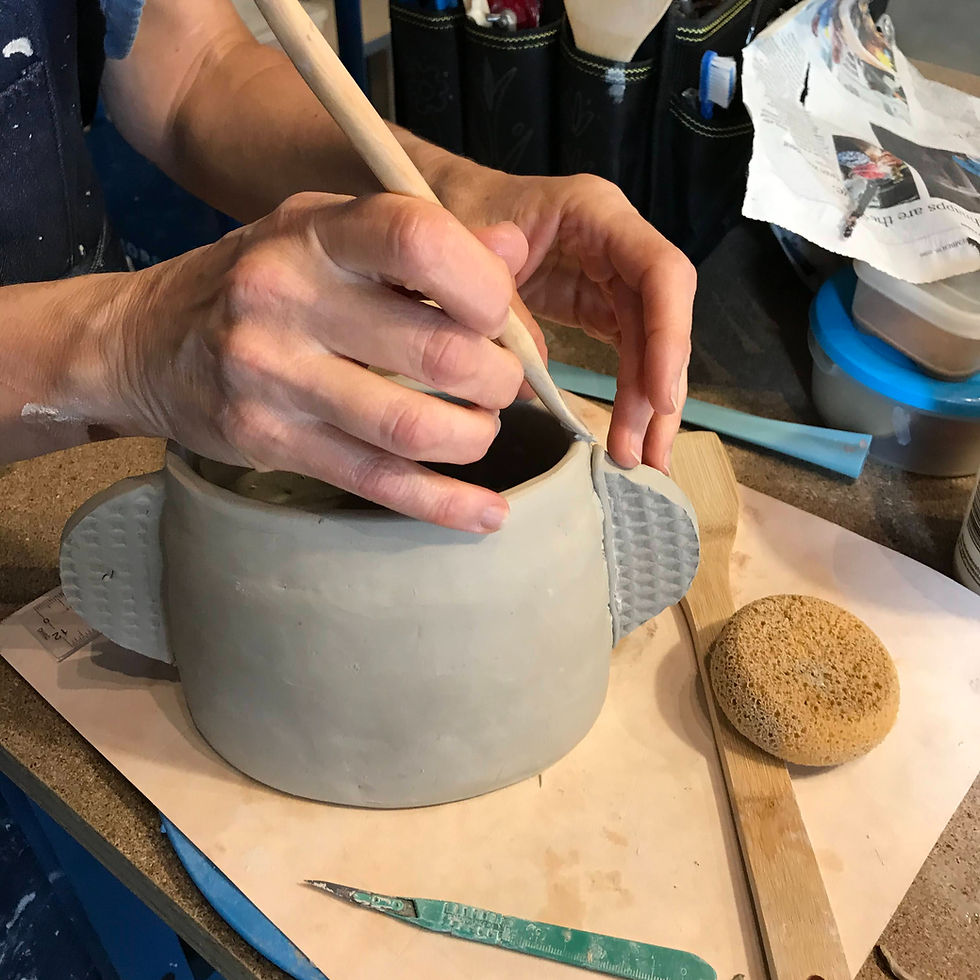
Working with clay is a physical experience. When throwing, you feel the moisture and resistance of the clay, the movement of the wheel, and the pressure of your fingertips as the form changes beneath your hands. Handbuilding requires the same kind of attention as you roll, shape, join and refine the clay.
That combination of touch, movement and concentration gives your mind something immediate to focus on. There is little room for distraction when you are centering clay on the wheel or figuring out how to make a form stand, curve or balance the way you want it to.
As your attention settles into what your hands are doing, you become absorbed in the process. Your mind quiets. Working with clay becomes calming and relaxing.

Embracing Imperfection
Clay rewards patience, but it also teaches you to live with imperfection. A piece may collapse on the wheel. A handle may not look quite right. A carefully planned form can become something completely different once you begin working with it.
You learn to adjust, solve the problem, try again or sometimes simply start over. Over time, mistakes become less discouraging and more a natural part of learning. There is satisfaction not only in making a successful piece, but in realizing how much better you have become at responding when things don't go as planned.
The Rhythm of Making
Pottery has its own rhythm. You prepare your clay, work through the steps of making, clean your tools and return another day to trim, decorate or glaze. Some things can be done immediately. Others have to wait until the clay is ready.
That rhythm slows you down. You begin to pay attention to the process rather than rushing toward the finished piece. And as the movements become more familiar, there is pleasure in the repetition itself: wedging clay, centering, pulling a wall, rolling a slab, attaching a handle or refining a surface.
Bailey building a ceramic lamp. Focusing on a handbuildt tabletop sculpture. Focusing on the center of a clay form on the potter's wheel.
Community and Connection
Pottery can be deeply personal, but it doesn't have to be solitary. In a shared studio, people may be completely absorbed in their own work while still working alongside others, exchanging ideas, asking questions and learning from what the people around them are making.
Over time, those repeated hours in the studio create relationships. You see someone finally master something they have struggled with. Someone shows you a technique you haven't tried. You admire a glaze combination, talk through a problem or simply share a worktable while each of you concentrates on your own piece.
That combination of individual focus and shared experience is one of the pleasures of working in a community pottery studio.
The Benefits Go Beyond the Pottery
You may come to pottery because you want to learn how to throw a bowl or make a mug. But what keeps people coming back to the studio is often about more than what comes out of the kiln.
There is the satisfaction of learning something difficult and gradually becoming better at it. There is time spent concentrating on one thing instead of many. There are mistakes that become lessons, ideas that become objects, and friendships that develop around the worktables and wheels.
And at the end of a few hours with clay, you have made something with your own hands. But you may also leave the studio a little calmer, more focused and already thinking about what you want to make next.
About Throw Clay LA
Whether you’re curious to try pottery for the first time or ready to develop your skills, Throw Clay LA offers one-time pottery experiences, six-week Build Skills courses, and six-week Refine & Explore courses in wheel throwing and handbuilding at our studio in Downtown Los Angeles.
We also offer pottery workshops and private pottery events for groups, while studio memberships provide experienced potters with dedicated space and time to pursue their own work, along with access to studio equipment, glazes, firing services and free weekly Member Clinics.